
A reflection on the cataloguing of a collection of flyers and leaflets, and on beginning work in a new language and a new organisation.
Since joining the archives team at HIS at the beginning of February, I have been undertaking a series of short projects in various parts of the archive, working on aspects of the collection which need attention before the Institute’s closure in 2028. I have been taking this as an opportunity to really settle into working in a new workplace, a new country, and a new language. The largest and most in depth of these sub-projects so far has been my work on our collection of flyers and leaflets. Over the last couple of months, I’ve been reordering, packaging, and classifying this fascinating set of records, making it more accessible to archive users. Now that this sub-project is largely complete, I wanted to write a short article outlining (and hopefully somewhat demystifying) the process of cataloguing and arranging such a collection.
The Task
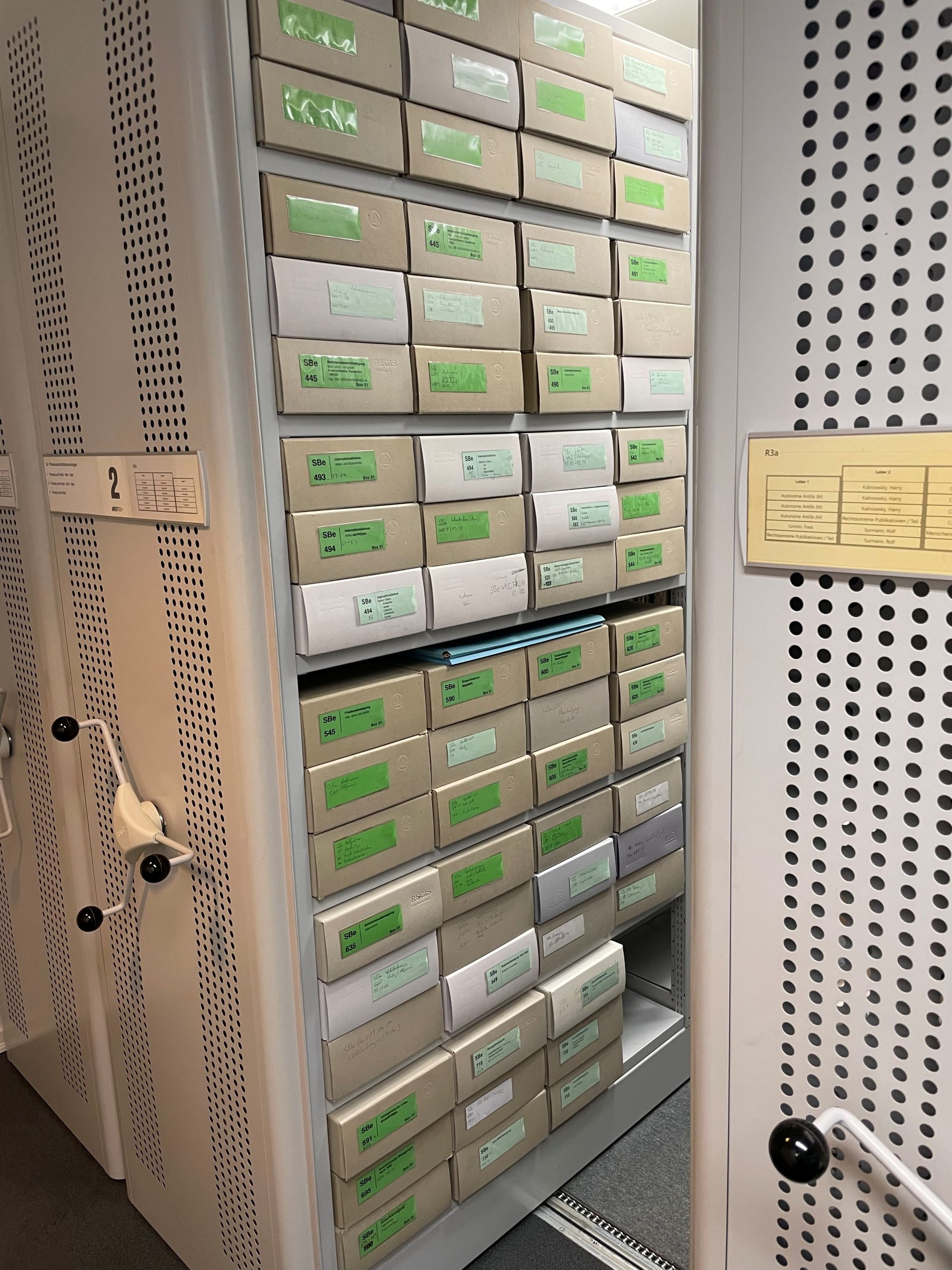
The collection consists of around 50 boxes of material, sorted into categories by subject matter. Before my work began, around 12 boxes were entirely unsorted, and the remaining ones only loosely so. The classification scheme – the method used to describe the categories into which the material is sorted – was also only partially accurate, having been worked on in fits and starts by several colleagues over the last several years, but never fully completed. As part of the cataloguing and sorting process, the classification scheme would need to be brought up to date, expanded upon and have its details filled in to accurately reflect the contents of the boxes it describes.
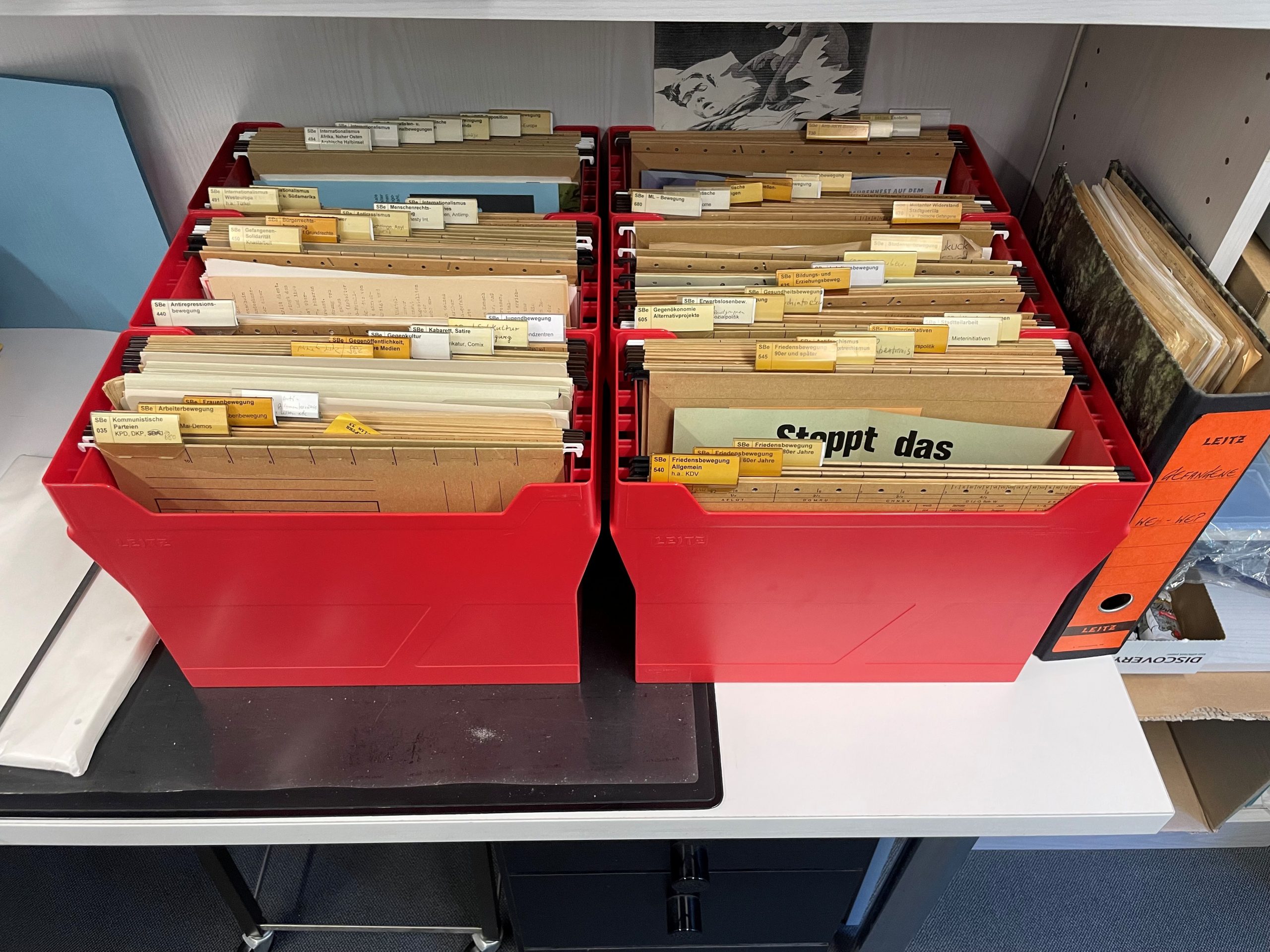
At first, this task appeared to be quite large (if pretty straight-forward) – too large to be undertaken in one single step. As such, it became necessary to split up the task, prioritise, and work out which elements would need to be finished first to allow subsequent segments to take place. The first step I took was to sort the unsorted material into rough categories, in a kind of “staging area” (several boxes of hanging folders in a colleague’s office). Although this was a long process, I endeavoured to make each individual decision as quick and painless as possible – each decision I made now would be checked later anyway when I sorted the leaflets into individual folders, and there’s no shame in creating a large pile in a box marked with a question-mark for a later date.
Following this initial “low-resolution” sorting step, the roughly sorted leaflets were sorted away into folders corresponding to more specific subject matter. For example, in the first step, material was sorted into the folder marked “Anti-Nuclear Power Movement”; in the second, this material was divided into smaller categories corresponding to individual nuclear power plants in Germany. This process was repeated for each roughly-sorted folder. As well as allowing the leaflet collection to be more easily browsed, this allowed me to see what we really had within the collection. Mostly, the smaller categories I sorted material into were already represented within the boxes. Sometimes, however, a new theme or subcategory would emerge, and need to be marked in the classification scheme.
This brings us to the final step of the process – updating and filling in the classification scheme. This document serves as both organisation and finding aid for the collection, and as such is vitally important for users and archivists alike. Despite this importance, it could only be done as the final step of the cataloguing process, once it had become clear what material was actually present within the boxes. This was, I must say, an immensely satisfying process: ordering the files and folders, sorting them into a legible structure, and organising them into an accessible and user-friendly structure. Slowly, a high-resolution picture emerged of the contents of the collection, and the whole thing began to make a lot more sense. Now that this final step has been completed, any further leaflets and flyers which emerge from the rest of the archive (and there will always be more!) can be quickly and easily sorted away into the correct folder in the correct box.
The Challenges
Although this project appeared relatively straight-forward at first, it did not remain so for long. On top of the sheer volume of work (50 boxes of material, each sheet of paper requiring a decision as to which of the several dozen categories it should belong to), many of the individual flyers posed considerable challenges. In the case of material published by autonomist groups, discerning much of the typical information necessary for sorting (date, publisher, etc.) was almost impossible. In many cases, years were simply left off the date of the pamphlet (“Come to the protest on the 17th of April! What year? This year, of course!”). Information about the publisher was often similarly absent (“Who published this flyer? We did, of course!”). In such cases, closer reading was necessary in order to determine a leaflet’s precise focus: repeating this process several dozen times throughout the project was a large time sink, but regrettably an unavoidable one.
The second, perhaps more obvious obstacle to processing was the fact that the collection is almost entirely in German (with smaller subsections in Turkish, English, and several other languages). While this did naturally slow down the speed at which I could process the documents, the more pertinent issue was the florid and often idiosyncratic vocabulary and style used by many left-wing groups. On top of continual study and improvement of my general German skills, then, I have found myself needing to brush up on niche terminology, turns of phrase, and rhetorical structures. I have found this personally enriching, and an excellent way to develop my knowledge of the language and culture I’m now surrounded by, but at first it was definitely a roadblock!
Linked to the above, the presence of large amounts of Marxist-Leninist material in the leaflet collection also proved somewhat challenging. As may be expected, these groups were enormously prolific in their publication habits, producing hundreds of flyers and leaflets and newsletters each year. On top of this proliferation, each group was subject to splits, changes in ideology, reformation under a new name, and insistence that they were, in fact, the principal organisation who would rebuild Communism in West Germany. Frequently, the names and logos of these organisations hardly differed from one another (for example, Spartacus was a Trotskyist group, while Spartakus was a Marxist-Leninist student organisation). In spite of this, it’s important to ensure that each group’s records are in fact correctly sorted out from one another – we don’t want the archives of this already complicated history to get even more complicated through sloppy cataloguing practices.
Interesting Finds
Although I found this collection interesting in its entirety, and enormously valuable as a research and cultural history resource, there were several particular topics which jumped out at me as particularly fascinating. The first of these was the wealth of information produced by the anti-nuclear-power movement. This movement (at least in this form) is largely a German phenomenon – I had been aware of its existence before working on this collection, but not in any great detail. What caught my interest was its broad-church, almost ecumenical approach to protesting nuclear power. Farmers, environmentalists, hippies, autonomists, and even the occasional right-winger banded together in marches, camps, demonstrations and occupations throughout West Germany to protest the construction, renovation, or activation of nuclear facilities. The reasons given by these groups for their opposition also ranged widely from the sensible (if stored improperly, nuclear waste can be hugely damaging to people and the environment) to the mildly ridiculous (there’s more than enough coal for the next two centuries, and it’s more environmentally friendly than uranium, anyway). This part of the collection was particularly valuable for me as a look into a very particularly German activist movement: how the movement worked, its goals and methodologies, how it fitted within the broader activist scene, and so on.
Another segment of the collection which I found particularly enlightening was that which dealt with internationalist solidarity efforts within Germany, particularly those related to the UK and Ireland. The hunger strikes and protests around conditions in the H-Blocks were covered extensively, with a focus on the anti-imperialist nature of the struggle in Northern Ireland. Similar attention was given to striking miners in the north of England in the 1980s. Here were events which I had learned about from a British perspective being discussed and reacted to from an entirely different standpoint. As the flyers in this collection discuss the Troubles and the strikes from the perspective of international solidarity (as opposed to solidarity within the UK), they provide quite a different picture of the situation. When I was still an undergraduate, one of the key things I learnt through my History degree was that a diversity of sources from a wide range of perspectives were essential to building up a good picture of an event or concept. These documents, then, are an excellent real-world example of this concept – the Troubles, as seen from abroad, take on a very different appearance to how they seem when viewed from within the UK.
Learning Points
For the last section of this article, let’s turn towards some more learning points which I have taken from working on the leaflet collection. The project served as an excellent introduction to the classification scheme system as used in the HIS archive. This method of organising archives isn’t all that common in the UK – at least in the archives I’ve worked in – so having a hands-on, dedicated introduction to it has been invaluable. Over the last few weeks, I’ve learned how the classification scheme works, some problems which can emerge when it’s developed inconsistently, and how it’s implemented in a collection from the ground up.
Additionally, this sub-project was an excellent introduction to the HIS collection. All of the principal themes of the archive are represented well amongst the flyers and leaflets – by sorting through them all, I feel like I have a much better idea of the breadth, scope, and character of the material stored elsewhere in the archive. The themes present in the collection are also still relevant to the work done by the research and publication wings of HIS. As such, I think this was a fitting place to begin, and one which sets me up to get to grips with the rest of the collection in a much better-informed way.
With this short article, I’ve attempted to create a window into my thought processes when working on a collection which is completely new to me. The leaflet collection project was a bit of a jump into the deep end which has required a lot of active thought and reflection on my part, so having the chance to lay it all out like this has been immensely valuable. Now, having finished this first segment of my work here at HIS, I feel well-prepared for the challenges and opportunities the rest of my time here will provide.
(nus, 19.05.2026)
Natalya Uemlianin-Stone is a qualified archivist from the United Kingdom.
Since February 2026 she is part of the archives team at the Hamburger Institut für Sozialforschung.
In her free time, Natalya writes a blog focusing on archives theory and practice at natsarchiveblog.substack.com.”